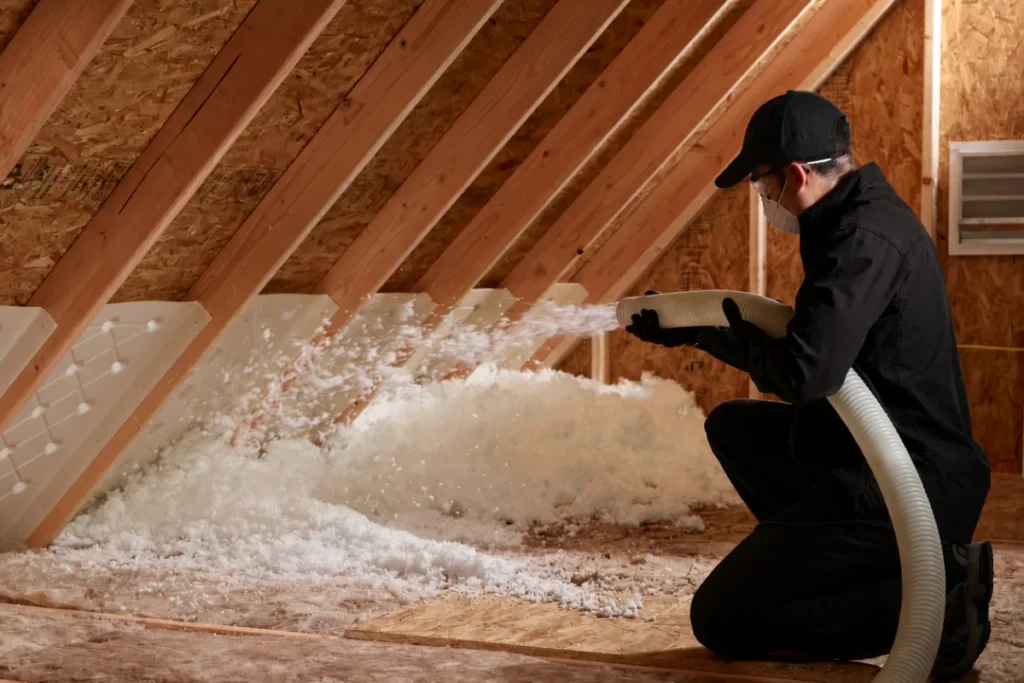
Dense-pack cellulose or fiberglass for attics and closed wall cavities, installed without opening drywall. Free on-site quotes, or call (343) 459-3623.
Get a Free Quote
Tell us about your project and we will get back to you within 24 hours.
We reply within one business day.
Material comparison
Cellulose vs Fiberglass Blown-In
Blown-in cellulose is a dense, recycled fibre that packs tightly into a cavity, which suits older Ottawa homes with irregular framing or wiring where a loose fill needs to move around obstructions. Blown-in fiberglass is lighter, resists moisture better in the raw material, and holds its R-value with less settling over time. Both are machine-installed through a hose rather than laid by hand, which is what makes them suited to filling open attic floors and closed wall cavities alike.
Where Blown-In Insulation Works
The same dense-pack method applies to two very different parts of a house.
Open Attic Floors
Blown across the full attic floor to reach the Ontario Building Code's R-60 target.
Closed Wall Cavities
Dense-packed through small access holes into existing walls.
Irregular Framing at Consistent Density
Fills tightly around wiring, plumbing, and other obstructions. Machine-metered installation keeps fill density even across the cavity.
Dense-Pack Blown-In for Closed Wall Cavities
Retrofitting insulation into a finished wall without opening it up.
Small Access Holes
A small hole is drilled per wall cavity.
Dense-Packed to Fill the Cavity
Material is blown in under pressure so it fills the full cavity height.
Holes Patched After
Access holes are patched and finished to match the surrounding wall once the cavity is filled.
Ottawa Insulation Experts provides professional blown-in insulation throughout Ottawa, Ontario. This service covers dense-pack cellulose and fiberglass installed by hose rather than laid by hand, which makes it suited to two different jobs: filling an open attic floor and retrofitting a finished wall cavity without removing drywall. Homeowners with older houses, irregular framing, or a wall that needs insulation added after the fact are the typical customers for this method. We match the material, cellulose or fiberglass, to the cavity and install it to a consistent, measured density rather than a rough fill.
Blown-In Insulation FAQs
Can blown-in insulation go into a wall that already has drywall up?
Yes. That is dense-pack blown-in insulation, installed through small drilled access holes rather than removing drywall, then patched afterward.
Should I choose cellulose or fiberglass for blown-in insulation?
Cellulose packs tightly around irregular framing and older wiring layouts, while fiberglass resists settling and holds its R-value over time. We recommend one based on your attic or wall condition during the assessment.
What does blown-in insulation cost in Ottawa?
Attic blown-in insulation typically runs $1.50 to $3.00 per square foot. Wall cavity dense-pack pricing depends on access and the number of cavities, confirmed with a free on-site quote.
Does blown-in insulation settle over time?
Some settling is normal with loose-fill material, more so with cellulose than fiberglass. Proper installation density at the time of the job reduces how much settling affects long-term R-value.
Is blown-in insulation only for attics?
No. The same dense-pack method is used in closed wall cavities as a retrofit option, in addition to open attic floors, which is the most common application.
Ready to Blow In New Insulation?
Free on-site quotes for blown-in insulation across Ottawa, attics and walls alike.
To provide the best experiences, we use technologies like cookies to store and/or access device information. Consenting to these technologies will allow us to process data such as browsing behaviour or unique IDs on this site. Not consenting or withdrawing consent, may adversely affect certain features and functions.
Functional
Always active
The technical storage or access is strictly necessary for the legitimate purpose of enabling the use of a specific service explicitly requested by the subscriber or user, or for the sole purpose of carrying out the transmission of a communication over an electronic communications network.
Preferences
The technical storage or access is necessary for the legitimate purpose of storing preferences that are not requested by the subscriber or user.
Statistics
The technical storage or access that is used exclusively for statistical purposes.The technical storage or access that is used exclusively for anonymous statistical purposes. Without a subpoena, voluntary compliance on the part of your Internet Service Provider, or additional records from a third party, information stored or retrieved for this purpose alone cannot usually be used to identify you.
Marketing
The technical storage or access is required to create user profiles to send advertising, or to track the user on a website or across several websites for similar marketing purposes.