Spray Foam Insulation Cost in Ottawa: Open-Cell vs. Closed-Cell Pricing
In 2026, spray foam insulation in Ottawa typically costs about $2 to $4 per square foot for open-cell foam and $4 to $7 per square foot for closed-cell foam at about 2 inches thick. Your actual quote can be higher or lower depending on the project.
That said, the number that matters isn’t just the contractor’s price per square foot.
You also need to know what type of foam they’re using, how thick they’re spraying it, what preparation is included, and whether the quoted price covers the work needed after the foam is installed.
Small jobs can be particularly difficult to price from a square-foot figure. A contractor still has equipment, labour, travel, preparation and setup costs even when there are only a few hundred square feet to spray.
So before comparing prices, make sure you’re comparing the same scope of work.
Ottawa spray foam prices at a glance
| Type of spray foam | Typical Ottawa price | Typical use |
|---|---|---|
| Open-cell | $2 to $4/sq. ft. | Interior wall and roof cavities where appropriate |
| Closed-cell | $4 to $7/sq. ft. at about 2 in. | Foundation areas, rim joists and assemblies needing higher R-value per inch |
| Rim joists | About $2 to $5/sq. ft. | Sealing and insulating the band/rim-joist area |
Project size, access, preparation, foam thickness, existing conditions and contractor minimum charges can all change the final price.
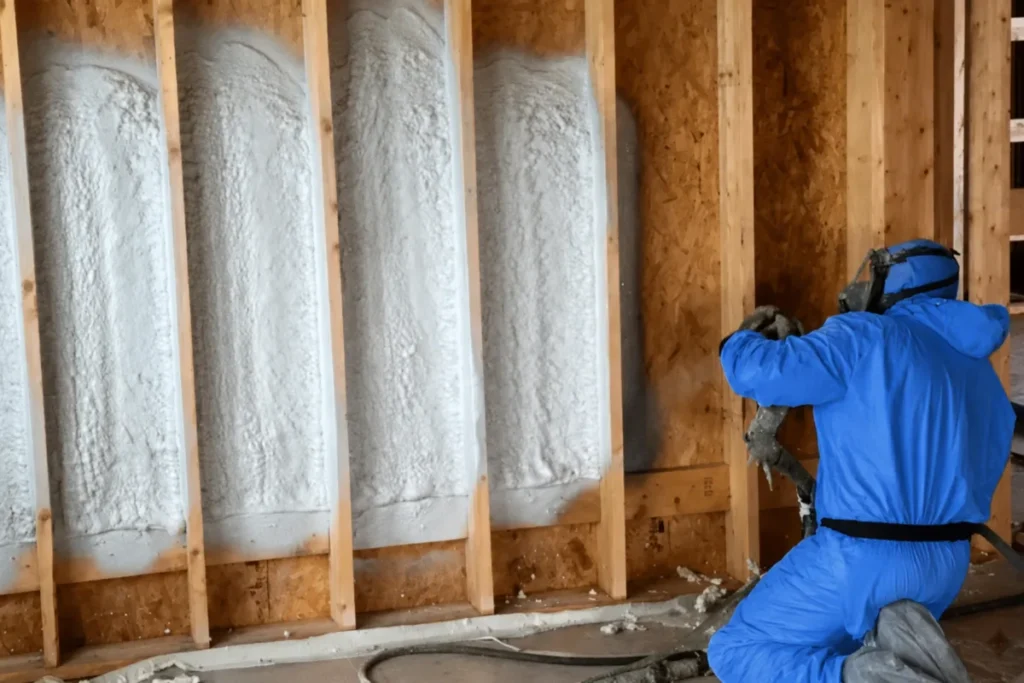
How spray foam pricing actually works
One reason spray foam prices can be confusing is that contractors may use different pricing units.
You may see:
- price per square foot
- price per board foot
- price per project
- or a combination of these
A board foot is one square foot of area sprayed to a thickness of one inch.
For example:
- 1 sq. ft. at 1 inch = 1 board foot
- 1 sq. ft. at 2 inches = 2 board feet
- 1,000 sq. ft. at 2 inches = 2,000 board feet
That means a quote for “1,000 square feet” does not tell you enough by itself.
You also need to know how many inches of foam are being installed.
For example, two contractors could quote the same 1,000-square-foot basement wall but install different thicknesses of foam. Comparing only the total price could therefore give you a misleading picture.
Open-cell spray foam cost
Open-cell spray foam is generally the less expensive of the two major spray-foam categories.
In Ottawa, open-cell foam typically costs about $2 to $4 per square foot, although the actual price depends heavily on thickness, access and the size of the job.
Open-cell polyurethane spray foam has a lower thermal resistance per inch than closed-cell foam. Natural Resources Canada lists a typical value of about R-3.6 per inch for open-cell polyurethane spray foam, although actual products vary.
Its lower density and expansion characteristics can make it useful for filling certain framed cavities, particularly where a large amount of cavity volume needs to be insulated.
However, open-cell foam should not automatically be treated as interchangeable with closed-cell foam.
The correct choice depends on the building assembly, moisture exposure, required R-value, air-sealing requirements and available cavity depth.
Open-cell foam and moisture
Open-cell foam is not a universal moisture-management solution.
Because it is more vapor permeable than closed-cell foam, the surrounding wall or roof assembly matters. Depending on the assembly, climate and location, additional vapor-control or moisture-management measures may be necessary.
That is why a contractor should be able to explain how the proposed insulation fits into the complete assembly, rather than simply saying that a particular foam is always the correct choice.
Closed-cell spray foam cost
Closed-cell spray foam generally costs more because it provides substantially more thermal resistance per inch and has different physical properties.
In Ottawa, closed-cell foam typically costs about $4 to $7 per square foot for around 2 inches installed. Product specifications and installation costs vary.
Natural Resources Canada gives a typical design value of approximately R-6 per inch for closed-cell polyurethane spray foam, with published product ranges varying around that figure.
Closed-cell foam can also provide air-barrier and moisture-resistance functions when installed appropriately. Natural Resources Canada notes that closed-cell polyurethane can be used below grade and can provide moisture resistance when applied to suitable clean masonry or concrete surfaces.
That makes it particularly relevant to certain foundation and rim-joist applications.
But more expensive does not automatically mean better for every location.
If a wall cavity can accommodate another insulation system that meets the required performance at a lower cost, closed-cell spray foam may not provide enough additional benefit to justify the price.
Typical Ottawa spray foam projects
The following examples show how contractors may approach different parts of a house.
Rim joists
Rim joists are one of the areas where spray foam can make practical sense because the work involves many irregular joints and potential air-leakage paths.
Spray foam for rim joists averages about $2 to $5 per square foot.
Your price can change considerably depending on:
- house size
- accessibility
- existing insulation
- preparation or removal
- number of penetrations
- required foam thickness
- contractor minimum charges
Ask whether the quote includes removal of old material and preparation before spraying.
Basement walls
Basement insulation is more complicated than simply choosing the highest-R-value product.
The contractor needs to consider:
- the condition of the foundation
- existing moisture problems
- whether the wall is concrete, masonry or framed
- interior finishes
- required insulation level
- moisture and vapor control
- electrical and plumbing penetrations
- how the wall will be finished afterward
Closed-cell foam may be appropriate for some basement applications, but rigid foam, framed assemblies, mineral wool or other approaches can also make sense depending on the construction.
Crawl spaces
Crawl spaces can present moisture, ventilation and access issues that affect both the insulation strategy and the price.
Before insulating, determine whether the crawl space has an existing moisture problem. Adding insulation without addressing water entry or other building-envelope problems does not solve the underlying issue.
Above-grade walls
If walls are already finished, spray foam can become significantly more complicated and expensive because access may require opening the wall.
If you’re already renovating and the wall cavities are exposed, the economics can be very different.
This is one reason the same insulation product can have dramatically different installed costs from one project to another.
Why two spray foam quotes can be very different
Suppose one contractor quotes $3,500 and another quotes $5,000.
That does not necessarily mean one contractor is charging too much.
The two quotes may not include the same work.
Check whether each quote specifies:
1. Foam type
Is it open-cell or closed-cell?
2. Thickness
How many inches are being installed?
3. Area
How many square feet are included?
4. Product
What manufacturer and product are being used?
5. Preparation
Does the price include cleaning, masking, removal or surface preparation?
6. Access
Are difficult areas, tight crawl spaces or high walls included?
7. Disposal
If existing insulation has to be removed, who pays for disposal?
8. Finishing
Will the contractor leave the foam exposed, or does the project include drywall, thermal protection or another required finish?
9. Minimum charge
Small spray-foam projects may have a minimum price that makes the effective cost per square foot much higher.
10. Taxes
Confirm whether HST is included.
The cheapest price per square foot is not necessarily the cheapest completed project.
What should be included in a spray foam quote?
A useful quote should make it possible to understand exactly what you’re buying.
Ideally, it should state:
- foam manufacturer and product
- open-cell or closed-cell
- installation thickness
- approximate square footage
- price or pricing basis
- preparation included
- removal included or excluded
- disposal included or excluded
- access requirements
- required protective or finishing work
- HST
- expected schedule
- warranty terms
If the contractor gives you only a total price with no description of the work, ask for more detail before comparing it with another quote.
Spray foam isn’t automatically the best insulation
Spray foam has useful properties, but it is not the right answer for every insulation problem.
Depending on the location, alternatives can include:
- blown-in cellulose
- fiberglass
- mineral wool
- rigid foam board
- dense-pack insulation
- combinations of insulation materials
The best approach depends on the assembly.
For example, an attic with large amounts of accessible space may be better suited to blown-in insulation than several inches of spray foam.
Similarly, a basement renovation may allow a framed wall with rigid foam and batt insulation instead of full-depth spray foam.
The important comparison is not simply spray foam vs. another product.
It is:
Which complete wall, ceiling, basement or roof assembly provides the required performance at a reasonable installed cost?
What about attic insulation?
Attics deserve separate consideration because spray foam is often promoted as a solution when the actual problem is simply insufficient attic insulation.
For many homes, blown-in fiberglass or cellulose can add substantial insulation without the cost of filling the entire attic assembly with spray foam.
The Home Renovation Savings program currently has a separate attic-insulation pathway that does not require a home energy assessment. Its published requirements include reaching R-50 for certain attic upgrades, with rebates depending on the insulation level before the work.
That makes it worth pricing an attic-insulation option separately rather than assuming spray foam is the only solution.
Ontario rebates and spray foam insulation
Ontario’s Home Renovation Savings program currently offers rebates for several insulation upgrades, including attic, foundation, exposed-floor and exterior-wall insulation.
However, eligibility depends on the specific upgrade and the program pathway.
For the assessment-based pathway, the program says homeowners must complete an initial home energy assessment before beginning the work, then complete at least two eligible upgrades. Foundation insulation, exterior-wall insulation, attic insulation and exposed-floor insulation are among the eligible categories.
The current published program information lists, among other incentives:
- foundation insulation rebates of up to $2,300
- exterior-wall insulation rebates of up to $3,600
- exposed-floor insulation rebates of $300
- attic insulation rebates that can reach $1,500 under the assessment-based pathway
The exact rebate depends on the existing insulation level, the improvement achieved, the home and the applicable program requirements.
There is also a separate attic-insulation pathway that does not require an energy assessment. Current program information lists maximum attic rebates of up to $1,250 depending on the starting insulation level.
Do not start eligible work before completing the required assessment if your chosen rebate pathway requires one.
Program rules can change, so homeowners should verify the current requirements directly with Home Renovation Savings before signing a contract.
How to compare spray foam quotes
When you receive two or three quotes, create a simple comparison.
For example:
| Item | Contractor A | Contractor B |
|---|---|---|
| Foam type | ||
| Product | ||
| Thickness | ||
| Area | ||
| Preparation | ||
| Removal | ||
| Disposal | ||
| Finishing | ||
| HST | ||
| Total |
Then compare the complete scope, not just the total.
A $4,000 quote that includes preparation and finishing can be more comparable to a $5,000 quote than a $3,500 quote that excludes both.
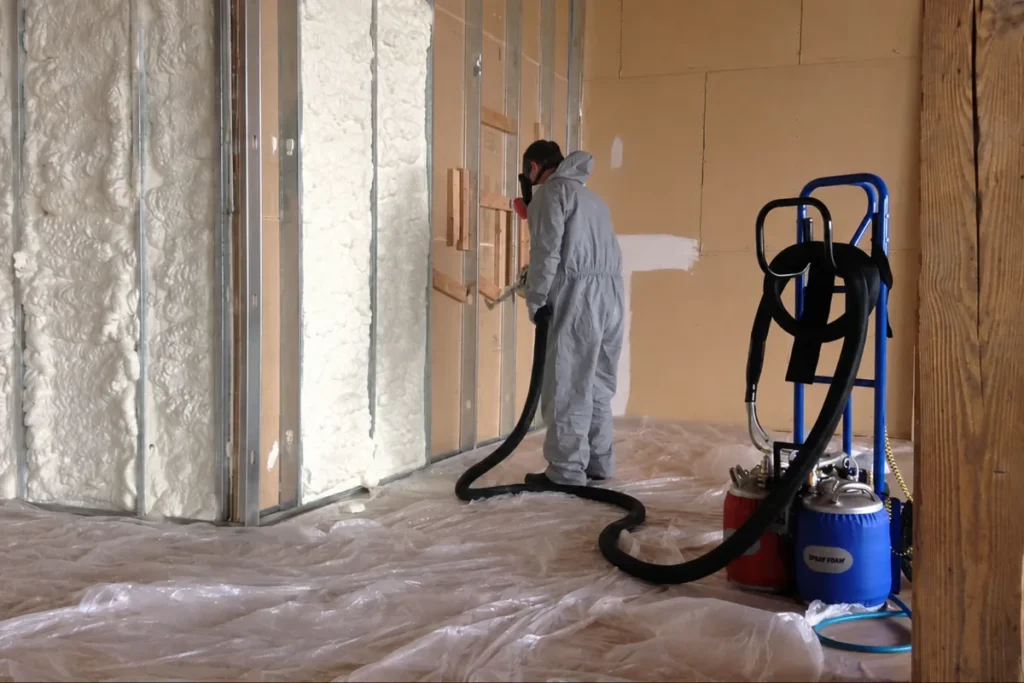
Questions to ask a spray foam contractor
Before accepting a quote, ask:
- What type of foam are you installing?
- What product are you using?
- How many inches will be installed?
- What R-value does the manufacturer specify for that thickness?
- Is the price based on square feet, board feet or the complete project?
- Does the quote include preparation?
- Does it include removal of existing insulation?
- Who handles disposal?
- Are there additional charges for difficult access?
- Does the quote include the finishing work required after spraying?
- What warranty is provided?
- Are there any minimum charges?
- Is HST included?
- If I’m applying for a rebate, does the work meet the program’s requirements?
- What happens if the actual spray area or required thickness changes?
If the contractor cannot clearly explain the scope, ask for the quote to be revised before comparing it with other contractors.
Is closed-cell foam worth paying more for?
Sometimes.
Closed-cell foam provides higher thermal resistance per inch than open-cell foam and can provide additional air and moisture-control functions in appropriate assemblies. Natural Resources Canada lists a typical value of about R-6 per inch for closed-cell polyurethane spray foam compared with about R-3.6 per inch for open-cell polyurethane spray foam.
That difference can matter where:
- wall or roof cavity depth is limited
- higher R-value per inch is important
- the assembly benefits from the foam’s moisture-resistance properties
- air sealing is a significant part of the project
But if you have plenty of cavity depth and the assembly can be designed effectively with a lower-cost insulation system, paying more for closed-cell foam may not be necessary.
The right question is therefore not:
“Is closed-cell better?”
It is:
“What does this particular assembly require, and is the additional cost buying a useful performance benefit?”
Frequently asked questions
How much does spray foam insulation cost in Ottawa?
We price open-cell spray foam at about $2 to $4 per square foot and closed-cell foam at about $4 to $7 per square foot at around 2 inches. Actual quotes vary by project and should be based on the required thickness and complete scope of work.
Is open-cell spray foam cheaper than closed-cell?
Generally, yes. Open-cell foam typically costs less per square foot, but it also provides less thermal resistance per inch.
How much does closed-cell spray foam cost?
About $4 to $7 per square foot at around 2 inches.
How much does rim-joist spray foam cost?
Rim-joist spray foam averages $2 to $5 per square foot, but the actual cost depends on house size, access, preparation, existing insulation and the required thickness.
Is spray foam good for basement walls?
It can be, but the appropriate insulation system depends on the foundation, moisture conditions, available space and the complete wall assembly. Closed-cell spray foam is one option, not an automatic requirement.
Is spray foam good for an attic?
It can be appropriate in certain roof assemblies, but conventional blown-in insulation may be a more economical solution for many accessible attics. Compare the complete assemblies and installation costs before deciding.
Does spray foam stop air leakage?
Properly installed spray foam can contribute to air sealing. The effectiveness depends on the product, installation quality and how the complete assembly is detailed.
Can I get a rebate for spray foam insulation?
Potentially, depending on the location of the insulation, your home, the applicable Home Renovation Savings pathway and the program’s current requirements. Some insulation rebates require an energy assessment and at least two qualifying upgrades. Check the current program rules before starting work.
Bottom line
For Ottawa homeowners, spray foam pricing is only useful when you know what you’re actually getting for the money.
In 2026, expect roughly $2 to $4 per square foot for open-cell and $4 to $7 per square foot for closed-cell at about 2 inches, but these figures don’t replace a detailed quote.
Before choosing a contractor, compare:
- foam type
- product
- thickness
- R-value
- square footage
- preparation
- removal and disposal
- access
- finishing requirements
- warranty
- HST
- rebate eligibility
Most importantly, don’t choose insulation based solely on the price per square foot.
A good spray-foam project is one where the insulation, air sealing, moisture control and finishing details work together as part of the building assembly.
That’s what you’re ultimately paying for, not just a certain number of inches of foam.