Attic Insulation Removal in Ottawa: Costs for Pest, Mould and Water Damage
If you’re looking into attic insulation removal in Ottawa, you’re probably dealing with a specific problem: mice, water damage, mould, old insulation, or an attic that needs to be opened up before new insulation goes in.
The cost can vary quite a bit depending on the size of the attic, the type of insulation, how accessible it is, and whether there is contamination or cleanup involved.
For straightforward insulation removal, a useful market-based budgeting range is about $1.50 to $3.50 per square foot. That puts a 1,000-square-foot attic at roughly $1,500 to $3,500 for removal alone, before repairs, remediation, or new insulation.
That is a budgeting range, not a guaranteed quote. A contractor needs to see the attic and understand what is being removed before giving you an accurate price.
How Much Does Attic Insulation Removal Cost in Ottawa?
The biggest factor is the amount of insulation being removed, but square footage is not the only thing that affects the price.
| Attic Size | Approximate Removal Budget |
|---|---|
| 600 sq. ft. | $900 to $2,100 |
| 800 sq. ft. | $1,200 to $2,800 |
| 1,000 sq. ft. | $1,500 to $3,500 |
| 1,200 sq. ft. | $1,800 to $4,200 |
| 1,500 sq. ft. | $2,250 to $5,250 |
These figures are intended for straightforward insulation removal. A contaminated attic, difficult access, unusual insulation material, extensive cleanup, or additional remediation can push the cost higher.
The main things that affect the price are:
- Attic size
- Type and depth of insulation
- How easily the crew can access the attic
- Whether the insulation is loose-fill, batt, blown-in, or another material
- Pest contamination
- Moisture or water damage
- Mould or other contamination
- Amount of debris that needs to be removed
- Bagging and disposal requirements
- Whether air sealing is required afterward
- Whether soffit or attic ventilation needs attention
- Whether roof, plumbing, electrical, or other repairs are needed
This is why two Ottawa homes with the same attic size can receive very different removal quotes.
Do You Actually Need to Remove the Insulation?
Not necessarily.
Old insulation is not automatically bad insulation.
If it is dry, relatively clean, evenly distributed, and still performing adequately, removing it may not be the best use of your money. Depending on the condition of the attic, adding new insulation on top of the existing material may be a better option.
Removal makes more sense when the existing insulation is contaminated, heavily disturbed, badly compacted, damaged by moisture, or needs to come out so that another problem can be properly inspected or repaired.
Before paying for a full tear-out, ask the contractor:
What problem are we solving by removing this insulation?
A good answer should be specific.
When Pest Damage Means Insulation Removal
Mice, squirrels, birds, and other pests can create problems in an attic.
They can leave droppings, nesting material, damaged insulation, odours, and debris. They can also enter through openings around the roofline, soffits, vents, fascia, or other parts of the building envelope.
But pest activity does not automatically mean every piece of insulation needs to be removed.
The first question is whether the pest problem has been stopped.
There is little value in replacing insulation while animals can still get back into the attic.
Depending on the situation, the work may involve:
- Identifying how the animals are getting in.
- Removing or repairing the entry point.
- Removing contaminated or heavily disturbed insulation.
- Cleaning the affected area.
- Inspecting for damaged wiring or other problems.
- Replacing the insulation that actually needs to be replaced.
If a large portion of the attic has been contaminated or the insulation has been extensively disturbed, full removal may make sense. In other cases, targeted removal can be enough.
If wildlife exclusion or pest control is required, make sure you know whether that work is included in the insulation contractor’s quote or needs to be handled separately.
Mould in the Attic
Mould is usually a moisture problem first and an insulation problem second.
If mould is present in an attic, replacing the insulation without addressing the source of the moisture does not solve the underlying problem.
Common sources include:
- Bathroom fans exhausting into the attic
- Roof leaks
- Plumbing leaks
- Condensation
- Poor attic ventilation
- Air leakage from the living space
- Warm, moist air reaching cold roof surfaces
The appropriate solution depends on what caused the moisture and how extensive the contamination is.
Sometimes insulation needs to be removed to properly inspect and clean the affected area. Sometimes only part of the insulation needs to be removed. More extensive mould contamination may require a separate remediation process.
Do not assume that a contractor quoting insulation removal is also providing mould remediation. Ask exactly what cleaning or remediation is included.
What About Water-Damaged Insulation?
Water damage needs to be investigated before deciding what to remove.
First, determine where the water came from.
It could be a roof leak, plumbing problem, condensation, or another source. That problem should be addressed before new insulation is installed.
Some insulation may be able to dry and remain in place depending on the material and extent of the exposure. Material that is heavily saturated, contaminated, permanently damaged, or otherwise unsuitable may need to be removed.
The important point is that wet insulation is a symptom, not the cause.
If a contractor recommends replacing the insulation, ask what caused the damage and whether that source has been repaired.
Be Careful With Vermiculite
If your home has older vermiculite insulation, do not treat it like ordinary blown-in insulation.
Some vermiculite insulation can contain asbestos. You should not disturb, vacuum, bag, or remove suspect material yourself.
If vermiculite is present, ask a qualified professional about appropriate testing and handling procedures before any removal work begins.
This can also change the price substantially because asbestos-related work is different from ordinary insulation removal.
How Is Attic Insulation Removed?
The removal process depends on the type of insulation and the condition of the attic.
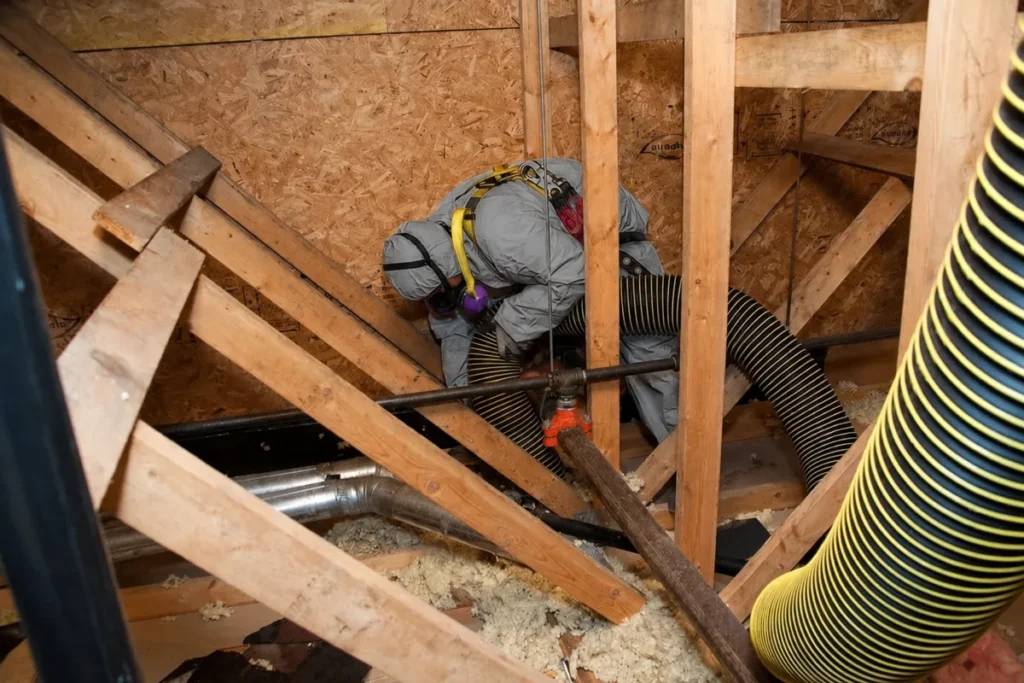
For loose-fill insulation, contractors commonly use specialized vacuum equipment to remove the material. Batt insulation is generally handled differently and may require manual removal.
A typical project can involve:
- Protecting the access area and the path into the home.
- Setting up removal equipment.
- Removing the existing insulation.
- Bagging or containing material as required.
- Removing debris and loose material.
- Inspecting the exposed attic.
- Identifying moisture, pest, ventilation, wiring, or air-leakage problems.
- Completing necessary repairs or preparation.
- Installing new insulation if included in the project.
The amount of cleanup required can vary significantly between attics.
A quote that looks cheaper on a per-square-foot basis may not be cheaper overall if it excludes disposal, cleanup, air sealing, or other necessary work.
What Should Be Included in the Quote?
Before comparing Ottawa insulation contractors, ask each company to explain exactly what the price includes.
| Work | What to Confirm |
|---|---|
| Insulation removal | What type and depth of insulation are being removed? |
| Labour | Is the quoted price all-inclusive? |
| Bagging/containment | How will the removed material be contained? |
| Disposal | Is disposal included? |
| Cleanup | Will the attic and access area be cleaned afterward? |
| Inspection | Will the exposed attic be inspected for problems? |
| Air sealing | Is air sealing included or priced separately? |
| Ventilation | Will soffit vents or baffles be checked? |
| Repairs | Are roof, plumbing, electrical, or pest repairs included? |
| New insulation | Is replacement insulation included in the quoted price? |
| Warranty | What parts of the work are covered and for how long? |
This makes quotes much easier to compare.
A $2,000 removal quote and a $3,000 removal quote may not be equivalent if one includes disposal and cleanup and the other does not.
What Happens After the Old Insulation Is Removed?
This is one of the most important parts of the job.
Once the insulation is out, the attic is easier to inspect. Problems that were hidden under the insulation may become visible.
A contractor should look for issues such as:
- Air leaks around ceiling penetrations
- Bathroom exhaust ducts
- Roof leaks
- Water staining
- Damaged roof sheathing
- Poor soffit ventilation
- Blocked or missing ventilation paths
- Pest entry points
- Damaged wiring
- Plumbing leaks
- Areas with excessive condensation
- Gaps around chimneys, pipes, ducts, and other penetrations
If these problems are ignored, installing new insulation may simply hide them again.
This is why insulation removal can sometimes be useful even when the insulation itself is not the original problem.
Choosing New Attic Insulation
If you are replacing the old insulation, the goal should not simply be to fill the attic with as much material as possible.
The installed insulation should provide the appropriate R-value, maintain proper ventilation paths, and be installed consistently across the attic.
Depending on the project, options can include:
- Blown-in fiberglass
- Blown-in cellulose
- Fiberglass batts
- Spray foam
- A combination of air sealing and blown-in insulation
The best option depends on the attic design, existing insulation, access, ventilation, air leakage, and the goals of the project.
The final R-value also depends on the material and installed depth. Do not compare insulation products only by thickness.
Should You Replace All the Old Insulation?
Not always.
If part of the insulation is in good condition, there may be no reason to remove it simply because it is old.
For example, an attic may have some insulation that is clean and dry while a smaller section has been affected by a roof leak or pest activity. In that situation, targeted removal and replacement may make more sense than removing everything.
On the other hand, if the insulation is extensively contaminated, badly disturbed, heavily compressed, or preventing proper inspection and repairs, full removal may be justified.
The right approach depends on the actual condition of the attic.
How to Choose an Ottawa Attic Insulation Contractor
When getting quotes, do not focus only on the lowest price.
Ask contractors:
- What exactly are you removing?
- Why do you recommend removing it?
- Is full removal necessary?
- Is disposal included?
- Is cleanup included?
- Will you inspect the attic after removal?
- Will you check for air leakage?
- Will you check soffit ventilation?
- What happens if you find mould?
- What happens if you find vermiculite?
- Are pest repairs included?
- Are roof or plumbing repairs included?
- What insulation do you recommend afterward?
- What R-value will be installed?
- Is the quote fixed or subject to additional charges?
A good contractor should be able to explain the reasoning behind the work, not just give you a square-foot price.
Frequently Asked Questions
How much does attic insulation removal cost in Ottawa?
For straightforward removal, a useful budgeting range is about $1.50 to $3.50 per square foot. A 1,000-square-foot attic would therefore have a rough removal budget of $1,500 to $3,500.
The actual price can be higher if there is contamination, difficult access, unusual insulation, extensive cleanup, or additional repair work.
Is attic insulation removal worth it?
It depends on the condition of the insulation and the problem you are trying to solve.
If the insulation is clean and performing adequately, removal may not be necessary. If it is contaminated, badly damaged, heavily disturbed, or preventing necessary repairs, removal can make sense.
Do mice mean I need all new insulation?
Not necessarily.
The pest entry point needs to be addressed first. Depending on the extent of contamination, only affected insulation may need to be removed.
Does mould mean all attic insulation has to be replaced?
No.
The moisture source needs to be identified first. The amount of insulation that needs to be removed depends on the extent and location of the contamination and the material involved.
Can wet attic insulation be left in place?
Sometimes, depending on the insulation type, extent of exposure, contamination, and whether it can properly dry. Heavily saturated, contaminated, or permanently damaged material may need to be removed.
How long does attic insulation removal take?
A straightforward project may take several hours, while larger, difficult-to-access, or contaminated attics can take longer.
The amount of insulation, attic layout, access, disposal requirements, and additional cleanup all affect the schedule.
Should I remove old insulation before adding new insulation?
Not automatically.
If the existing insulation is clean, dry, and in reasonable condition, adding insulation may be more practical than removing it. Removal is more appropriate when the existing material has a specific problem that needs to be addressed.
What if I find vermiculite?
Stop before disturbing it.
Some older vermiculite insulation may contain asbestos. Have the material assessed by an appropriately qualified professional before proceeding with removal.
Getting an Accurate Attic Insulation Removal Price
The best way to get an accurate price is to have the attic assessed before the work is scheduled.
Give the contractor information about:
- The approximate attic size
- The age of the home
- The type of insulation, if known
- Any history of mice or other pests
- Any mould or moisture concerns
- Any known roof or plumbing leaks
- Whether you want removal only or removal and replacement
If possible, have the contractor inspect the attic rather than relying only on the home’s square footage.
A useful quote should tell you what is being removed, how it will be handled, what cleanup and disposal are included, and what additional work may be required.
Most importantly, do not assume that removing all of the insulation is automatically the right solution.
Sometimes the best attic project is a full removal and replacement. Sometimes it is targeted removal. And sometimes the existing insulation can stay and simply be topped up.
The right answer depends on what is actually happening in the attic.