Blown-In Insulation in Ottawa: Cost to Upgrade Your Attic to R-60
If your Ottawa home has an older or under-insulated attic, adding blown-in insulation can improve winter comfort and reduce heat loss. But an attic insulation upgrade is about more than simply blowing in enough material to reach R-60.
Before adding insulation, the attic should be checked for existing insulation, air leaks, moisture, ventilation, and areas where insulation is missing or compressed. In some homes, a simple top-up is the right approach. In others, air sealing, ventilation work, or removal of damaged insulation needs to happen first.
If you’re considering an R-60 upgrade, start with these questions:
- How much insulation is already in the attic?
- Is it dry and in usable condition?
- Does the ceiling need air sealing?
- Are the soffit and roof ventilation paths clear?
- What insulation product will be installed?
- What depth is required for that specific product?
- Does the work qualify for a current rebate?
The last point is important. The current Ontario Home Renovation Savings attic program does not simply require every home to reach R-60. For qualifying homes, the attic-insulation stream has specific starting insulation levels, minimum upgrade levels, and rebate limits.
What Does R-60 Mean?
R-value measures how well insulation resists heat flow. The higher the R-value, the greater the resistance to heat moving through the insulated assembly.
R-60 is a high attic-insulation target and is commonly used when upgrading Ottawa homes. However, it should not be described as a universal legal requirement for every existing attic.
Building Code requirements, retrofit recommendations, and rebate requirements are different things. Ontario’s current Building Code is established under O. Reg. 163/24, which adopts the 2020 National Building Code with Ontario amendments.
For an existing attic, the sensible starting point is to determine what is already there. Insulation depth, type, condition, and coverage all matter.
The amount of material required to reach R-60 also depends on the product. Cellulose and loose-fill fiberglass have different rated performance and installation requirements, so there is no universal rule that a particular number of inches always equals R-60.
A contractor should be able to tell you:
- The insulation manufacturer
- The exact product
- The target R-value
- The required installed depth
- Whether the quoted depth accounts for the product’s installation requirements
Does Your Ottawa Attic Need More Insulation?
Several signs can indicate that an attic may benefit from an insulation upgrade. None of them, by itself, proves that adding insulation is the answer.
Thin or Uneven Insulation
This is one of the easiest things to identify during an attic inspection.
If insulation is shallow, compressed, or missing in sections, the ceiling can lose more heat than it should. Gaps around the perimeter can also leave portions of the ceiling colder than the rest.
Natural Resources Canada recommends checking existing insulation for its type, condition, depth, and coverage before adding more.
Cold Rooms Upstairs
A cold bedroom does not necessarily mean the attic needs more insulation.
Air leakage can contribute to the problem. So can windows, exterior walls, ductwork, uneven heating, or other parts of the building envelope.
If one room is consistently colder than the rest of the house, investigate the cause rather than assuming another layer of insulation will solve it.
High Heating Bills
More insulation can reduce heat loss, but there is no honest way to promise every homeowner a specific annual dollar saving.
The result depends on the home’s existing insulation, air leakage, heating system, floor area, thermostat settings, weather, and other factors.
Be cautious about insulation quotes that promise a guaranteed amount of annual savings without showing how the number was calculated.
Gaps and Ceiling Penetrations
Look for openings around:
- Plumbing pipes
- Electrical wiring
- Attic hatches
- Recessed lights
- Chimneys
- Ducts
- Ceiling fixtures
- Top plates
- Other penetrations through the ceiling
These openings can allow warm indoor air to move into the attic. That air also carries moisture.
Natural Resources Canada specifically recommends addressing attic air leakage because warm, moist indoor air entering a cold attic can contribute to condensation and other moisture problems.
Ice Dams
Ice dams can form when heat escaping into the roof area warms part of the roof, causing snow to melt and then refreeze near colder roof edges.
Improving insulation and air sealing can reduce conditions that contribute to ice dams, but it is not a guarantee that they will disappear. Roof design, snow accumulation, ventilation, thermal bridging, and air leakage can all affect the problem.
Natural Resources Canada identifies thorough air sealing and insulation as important parts of ice-dam prevention, while also noting that complicated roofs can remain more prone to ice damming.
Air Sealing Comes Before Insulation
Adding insulation over an air leak does not fix the air leak.
Common attic leakage points include:
- Plumbing penetrations
- Electrical penetrations
- Attic hatches
- Top plates
- Recessed lights
- Chimney and flue openings
- Duct penetrations
- Wiring holes
- Gaps around ceiling fixtures
It helps to think of air sealing and insulation as two separate jobs.
Air sealing reduces unwanted movement of indoor air into the attic.
Insulation slows heat transfer through the ceiling.
You need the insulation to do its job, but adding more insulation over an uncontrolled air leak is not a substitute for sealing it.
Natural Resources Canada recommends concentrating on air sealing before or as part of an attic insulation upgrade.
How a Blown-In Insulation Upgrade Works
A good installation starts with an inspection.
1. Inspect the Attic
The contractor should check:
- Existing insulation depth
- Insulation type
- Moisture or water damage
- Mould or pest contamination
- Air leakage
- Soffit and roof ventilation
- Electrical and mechanical penetrations
- Attic access
- Available space for additional insulation
If the insulation is wet, the source of the moisture should be addressed first. Adding new insulation over an active moisture problem is not a proper fix.
Natural Resources Canada recommends correcting moisture problems before covering them with new insulation.
2. Air Seal the Ceiling
Accessible gaps and penetrations should be sealed before the new insulation is installed.
The exact materials and methods depend on what is being sealed and where it is located.
3. Protect the Ventilation
If the attic relies on soffit ventilation, the ventilation path needs to remain open.
Baffles are commonly used to keep insulation from blocking airflow at the eaves. The correct approach depends on the construction of the particular attic.
Ventilation is important, but it is not a replacement for air sealing. Natural Resources Canada specifically notes that ventilation does not solve problems caused by air leakage.
4. Install the Blown-In Insulation
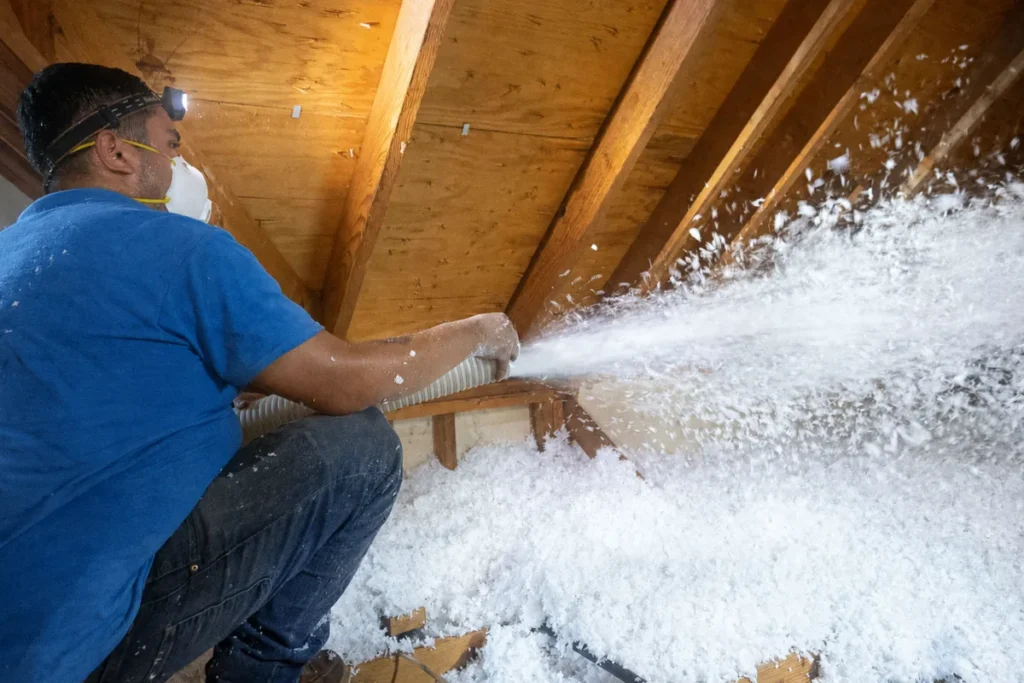
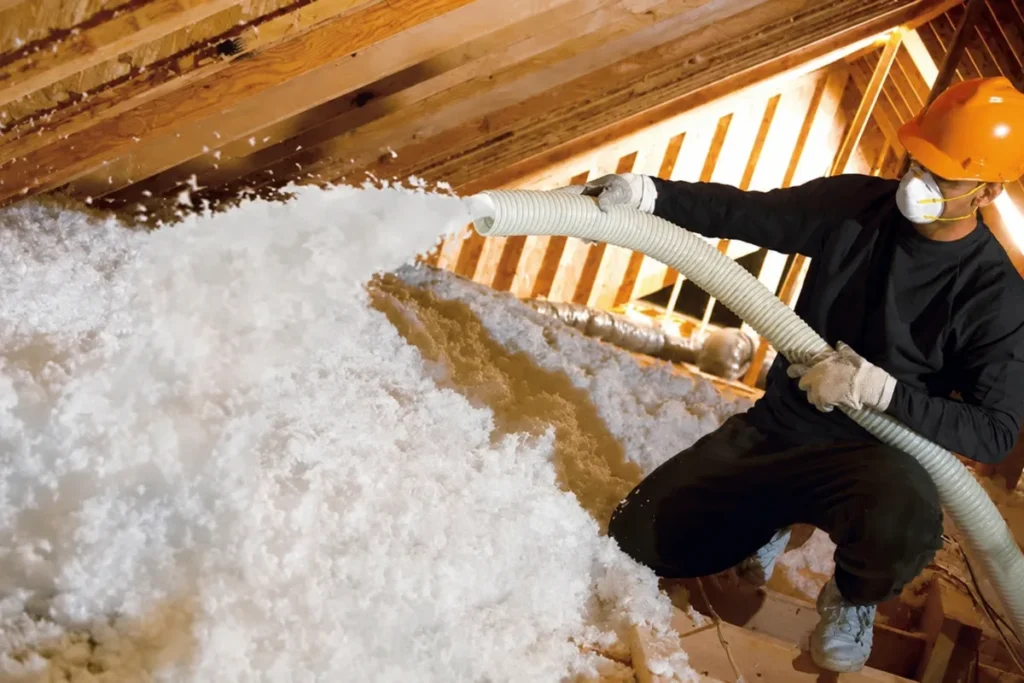
Loose-fill insulation is distributed across the attic floor using a blowing machine and hose.
The installer should work to the depth required for the particular product and specified R-value.
5. Check the Finished Coverage
The insulation should be reasonably consistent across the attic rather than heavily piled in some areas and thin in others.
Ask the contractor what product was installed, what R-value was targeted, and what installed depth corresponds to that target.
6. Finish the Job Properly
The attic hatch should be insulated and sealed, and the work area should be left clean.
An attic hatch that allows warm indoor air to leak into the attic can undermine an otherwise good insulation installation.
What Does Blown-In Insulation Cost in Ottawa?
There is no single Ottawa price for an attic insulation upgrade.
A small attic with good existing insulation is a different job from a large attic that needs extensive air sealing, new baffles, removal, or other preparation.
Current published Ottawa pricing gives a useful starting point. One Ottawa contractor pricing source lists roughly $1.50 to $3.00 per square foot for blown-in attic insulation, while another local service provider advertises starting pricing of $2.50 per square foot for blown-in attic insulation based on a 1,000-square-foot attic.
That puts a basic 1,000-square-foot job in a broad planning range of roughly $1,500 to $3,000 before unusual preparation or removal costs, although actual quotes can be higher depending on the scope.
What Ottawa Homeowners Have Actually Reported Paying
Public Ottawa homeowner discussions also provide examples of real quoted prices. These are individual reports, not a statistically representative market survey.
Reported examples include:
| Attic / project | Reported quote |
|---|---|
| About 600 sq. ft., blown-in insulation to R-60 | $2,600 |
| About 780 sq. ft., R-25 to R-60 | $2,300 |
| About 1,200 sq. ft., blown fiberglass to R-60 | About $2,800 |
| Another Ottawa project with baffles | About $3,600 |
These reports should be treated as anecdotal because the scope of work, insulation product, air sealing, baffles, and rebate treatment were not identical in every case.
For those four reported figures, the simple average is approximately $2,825. Applying a narrow planning band of 5% below to 10% above that average gives approximately $2,684 to $3,108.
That range is useful as a benchmark for comparing quotes, but it should not be presented as the official Ottawa market price. The individual projects were different sizes and scopes.
The main factors affecting the final price are:
- Attic size
- Existing insulation
- Amount of new insulation required
- Insulation type
- Air sealing
- Accessibility
- Number of baffles or ventilation modifications
- Removal and disposal
- Moisture or contamination issues
- Attic hatch work
- Other preparation
A useful quote should identify:
- Existing estimated R-value
- Target R-value
- Insulation product
- Installed depth
- Air sealing
- Baffles or ventilation work
- Attic hatch treatment
- Removal and disposal, if required
- Labour
- Cleanup
- Any rebate assumptions
Two quotes with the same total price can represent very different work.
Cellulose vs. Fiberglass Blown-In Insulation
Both cellulose and loose-fill fiberglass are used for attic insulation.
The better question is not simply which material is “best.” Look at the particular product, its rated R-value, required installation depth, installation method, and manufacturer requirements.
Ask the contractor for the actual product name and manufacturer.
Be skeptical of blanket claims such as “X inches always equals R-60.” The required depth varies by product.
The price can also differ. Published Ottawa pricing sources currently put blown-in cellulose around $1.50 to $2.50 per square foot for attic applications, while loose-fill fiberglass is commonly listed somewhat higher. These are planning figures rather than guaranteed contractor prices.
Should Existing Insulation Be Removed?
Not necessarily.
If the existing insulation is dry, usable, reasonably distributed, and free of contamination, a top-up may be all that is needed.
Removal or remediation becomes more appropriate when the insulation is:
- Wet
- Mould-contaminated
- Heavily contaminated by pests
- Severely damaged
- Otherwise unsuitable for continued use
Natural Resources Canada recommends removing insulation that has been damaged or contaminated, while dry insulation in usable condition can often remain in place.
Watch for Vermiculite
There is an important exception involving vermiculite insulation.
Natural Resources Canada warns homeowners not to disturb vermiculite insulation because some vermiculite products may contain asbestos.
If you discover vermiculite in the attic, stop before disturbing it and have the material properly assessed.
Ottawa Attic Insulation Rebates
The current Home Renovation Savings program includes an attic-insulation rebate for qualifying Ontario homes.
For the attic stream, the current program lists these levels:
| Existing insulation | Minimum level after upgrade | Maximum rebate |
|---|---|---|
| R-12 or less | R-50 | $1,250 |
| Greater than R-12 to R-25 | R-50 | $1,000 |
| Greater than R-25 to R-35 | R-50 | $800 |
The rebate is calculated at 50% of the eligible attic-insulation cost after tax, subject to the applicable maximum. The program requires a participating contractor for this attic rebate.
The program also has eligibility requirements covering the homeowner, property type, heating system or electricity connection, and other conditions. Check the current program rules before signing a contract because rebate requirements can change.
Importantly, the current attic rebate target is R-50, not R-60. Reaching R-60 may still make sense as a retrofit goal, but it should not be presented as a requirement of the rebate itself.
How to Compare Ottawa Insulation Contractors
Price matters, but it should not be the only thing you compare.
A good contractor should be able to answer basic questions without relying on vague sales claims.
What is currently in my attic?
Ask for an actual measurement rather than a guess.
What R-value are you installing?
Get the target R-value in writing.
What product are you using?
Ask for the manufacturer and product name.
How deep will the insulation be?
The depth should make sense for the specific product and target R-value.
Are you air sealing?
If air sealing is not included, ask why.
How will you protect the soffit vents?
The contractor should explain how the ventilation path will remain clear.
Are you removing the existing insulation?
If yes, find out why.
If the insulation is dry and usable, ask whether a top-up is possible instead.
Is the rebate included in the advertised price?
Make sure you know whether the quoted price is before or after any expected rebate.
Can I get the scope in writing?
The written quote should identify the materials, target R-value, installed depth, preparation, labour, cleanup, exclusions, and any assumptions about rebates.
Top-Up vs. Full Replacement
For many Ottawa attics, a top-up is the simpler solution.
If the existing insulation is dry, reasonably clean, and in usable condition, there may be little reason to remove it simply because it is old.
Full removal makes more sense when the existing material is contaminated, damaged, wet, or otherwise interfering with the work.
The decision should come from the condition of the attic rather than simply the age of the insulation.
Frequently Asked Questions
Is R-60 required in every Ottawa attic?
No.
R-60 is a high insulation target, but it should not be treated as a universal legal requirement for every existing Ottawa attic. The appropriate target depends on the building, applicable requirements, retrofit objectives, and any rebate program being used.
Is blown-in insulation good for Ottawa winters?
Yes, when it is installed correctly.
The insulation itself is only part of the attic assembly. Air sealing, moisture control, ventilation, and complete coverage all affect the finished result.
Will more insulation eliminate ice dams?
Not necessarily.
Better insulation and air sealing can reduce conditions that contribute to ice dams, but roof design, ventilation, snow accumulation, and air leakage also matter.
Should air sealing be done before insulation?
Generally, yes.
If warm indoor air is leaking into the attic, adding more insulation does not solve that leakage. The two issues should be addressed separately.
Can I install blown-in insulation myself?
Some homeowners can install loose-fill insulation themselves, but attic work involves more than operating the blowing machine.
Air sealing, ventilation, electrical and mechanical penetrations, moisture problems, and consistent insulation depth all need to be handled properly.
DIY installation also does not qualify for the current Home Renovation Savings attic rebate.
How long does an attic insulation upgrade take?
It depends on the attic and the amount of preparation required.
A straightforward top-up can be relatively quick. Jobs involving extensive air sealing, removal, ventilation work, or contamination can take longer.
How do I know whether my attic needs more insulation?
Start with an inspection.
Measure the existing insulation and check its condition and coverage. At the same time, look for air leaks, moisture problems, blocked ventilation, and areas where insulation is missing or compressed.
Is upgrading attic insulation worth it?
It can be, particularly if the attic has relatively little insulation or significant air leakage.
The financial return varies from house to house. Consider the existing attic condition, cost of the work, expected comfort and energy improvements, and any available rebate before deciding.
Bottom Line
An Ottawa attic insulation upgrade should be about more than reaching a particular R-value.
First, find out what is already in the attic. Fix moisture problems and air leaks, make sure ventilation paths remain open, and then install the appropriate amount of insulation for the specific product being used.
For budgeting, current Ottawa pricing sources put many blown-in attic projects in the low-thousands-of-dollars range, while publicly reported homeowner quotes show that the actual price can vary substantially depending on attic size and scope.
When comparing contractors, don’t look at the total price alone. Compare the scope of work, insulation product, target R-value, installed depth, air sealing, ventilation work, preparation, cleanup, and how the quote handles rebates.
A good attic upgrade is one where you know exactly what you’re paying for before the insulation hose comes through the attic hatch.